Namaste! In the attempt to keep you all (this means you mom and dad) up to date with my Indian travels, here are the pictures from the last week spent in Bombay, Delhi, and Agra. In a further attempt to upload these photos before these cafe owners turn off the WiFi and kick me out, further dialogue about India will have to wait.
Wednesday, October 9, 2013
Wednesday, September 25, 2013
How You Know You've Been in India 1 Month
1.
You ask
for extra red pepper flake packets for your domino’s pizza that suddenly seems
a bit too bland.
2.
Your clothes never match in color or pattern but
that’s cool because no one’s really does.
3.
You don’t wear shoes, ever.
4.
You’re able to cross a busy two way street at
rush hour with the confidence of Moses parting the red sea.
5.
You know and have named every street dog in your
neighborhood.
6.
You've accepted the fact that the YMCA is still
a relevant and popular dance in almost every night club.
7.
You’re no longer fazed driving into oncoming
traffic.
8.
You walk into an Internet café with absolutely no
expectations of there being Internet or it being a café.
9.
When you hear a car playing the happy birthday
song you back up, it’s no one’s birthday, the car is just going in reverse.
10.
You can eat an entire meal, including rice, with
only one hand.
11.
You’re able to push and bully your way to the
front of lines with no remorse- large crowds call the ‘eat or be eaten’ mentality
into focus.
12.
You start charging to have your picture taken.
13.
You've mastered the Indian head swivel which can
mean yes or no depending on the occasion.
14.
You always have a roll of toilet paper on you.
15.
You’re not constantly sweating, you’re
constantly glistening.
So this post is coming quite late but as I might have mentioned before, reliable Internet is as mythical as the Hindu gods. Below are the pictures from the Ganpati festival- I’m sure
the Internet can give a much better and in-depth analysis of this Hindu holiday
but here’s a very quick and watered down foreigners version: Ever since I arrived in India all I’ve been
hearing talk about is the Ganpati festival.
Ganpati is a 10 day celebration of one of the most important Hindu gods,
Ganesh, a God with the head of an elephant, body of a man and 4 outstretched
arms. At the beginning of the holiday
every family brings a statue of Ganesh into their homes and prepares an
appropriate alter baring flowers, gifts and incense. Likewise, huge Ganesh idols are placed all
around town with extremely elaborate setups ranging from robotic peacocks to
waterfalls to red carpets and chandeliers.
At the end of the festival a huge procession takes place across town
where all of the idols are immersed into the river (or carefully selected water
tanks for the eco conscious). The
procession is a 36 hour affair of nonstop drumming, dancing, lights and music
that starts from one end of Pune, or your respected town, and ends at the river
where the idols are immersed.
Alter for Ganesh in my host family's house
Prayer before immersing Ganesh in designated water tanks
This has absolutely nothing to do with India or the Ganpati festival, but I miss my puppy!
Saturday, September 14, 2013
Pardon the Interruption.
It’s important to have a sense of
humor in India as over the course of one day, you mind find yourself running
into any number of little interruptions that leave you questioning the
reasoning behind the chaos. Mainly
because you never know when your rickshaw is going to break down in the middle
of nowhere in the pouring rain, you may put the majority of your clothes in the
wash and they may come out purple, you might have a bite of curry drenched/ tear
inducing food before realizing there’s no water in sight, it may take you 5
minutes to cross a one way street, sleeping patterns might become a little staggered
as you fall asleep to drum circles and wake up to what sounds like a highway
running through a tropical rain forest, at the foreign commissioner’s office you’ll
have to deal with the disappointed faces that you’re an American who hasn't
personally met Jack Bauer, you may find yourself sleeping on a hotel floor
amongst 20 other grasshoppers and unnamed insects, maybe you’ll pay to use a
restroom that doesn't even supply toilet paper, you might visit 10 different
Internet cafes to find that the term ‘Internet’ is used very loosely here, the
power may randomly go out at any given time, and possibly you’ll find yourself
at a traditional Indian dance recital where they suddenly break out into the
robot doing an interpretive dance of space travel. Not that I would have personal experience of
any of these occurrences or anything…
The basic point is that there is an
order and flow to Indian lifestyle and the main component of finding this order
is to continually expect the unexpected.
Maybe your rickshaw broke down, but there are 5 more people ready to
help you get where you’re going. At the
end of the day purple clothes make as good of clothes as those of any other
color (and at least now all of your outfits are color coordinated). It may take 5 minutes to cross the street but
is your day really so rushed you can’t spare those 5 critical minutes? Internet may only be seldom available in 10
minute intervals but there are books to be read and places to go that computer
fixation could hold you back from otherwise.
And where else in the world are you going to see a group of Indian
dancers break out into the robot as a tribute to the first Indian astronaut in
space?
*PS: I really tried to come up with a cute justification for
sleeping next to full grown grasshoppers and how it was a learning experience
if put in the right perspective but seriously, that one was just gross.
Tuesday, September 10, 2013
The Ancient Buddhist Caves of Aganta & Ellora
As I’ve been traveling and becoming accustomed to Indian
lifestyle the past two weeks, one important aspect of my time here completely
skipped my mind- I have to go to school.
I started my first week of classes last week and quickly learned this
won’t be like my time studying abroad in Turkey. As an American exchange student in Turkey,
school for me basically meant showing up for homeroom then spending the rest of
the day meandering between playing piano, violin, and taking trips to the beach
(while passing every course with flying colors).
Although disappointed that studying
turns out to be a critical element of studying abroad, it’s been interesting
relearning and discussing topics from an Indian aspect. For example, in an American Social Justice
class race would be a driving theme of the majority of lectures. In an Indian Social Justice class, however,
the caste system is the topic of discussion involving inequality among citizens
that are supposedly granted equal rights.
Just as in America there are underlying judgments placed among different
races, this same judgment is used among the different castes of Indian society. I’m also becoming somewhat obsessed with my
Public Health class- mainly because a lot of my previous studies in Public
Health in America have almost no relevance to Public Health in India. Of course the basic framework of Public
Health is the same everywhere: which populations are at risk of which diseases,
how to educate and promote behavior change, incorporating community involvement,
development of sustainable programs, etc, etc.
Health and wellness is largely marketed toward the American population through
the pharmacological industry and education is started from a young age with the
main topics concerning nutrition and sex education. Health promotion and education in India,
however, is fighting the same struggle as its continually evolving society:
tradition vs. modernization. Traditionally,
India has survived on traditional forms of medicine for thousands of years such
as Ayurvedic medicine, yoga and homeopathic remedies. As more western styles of medicine have been taking
a claim over the healthcare field over the past 50 years or so, more and more
Indians are fighting for their traditional forms of healing to be recognized
not only as alternative forms of medicine but real and effective forms which
have sustained their society for thousands of years.
After a long first week of classes,
the majority of our group left Friday night for a weekend trip to visit the
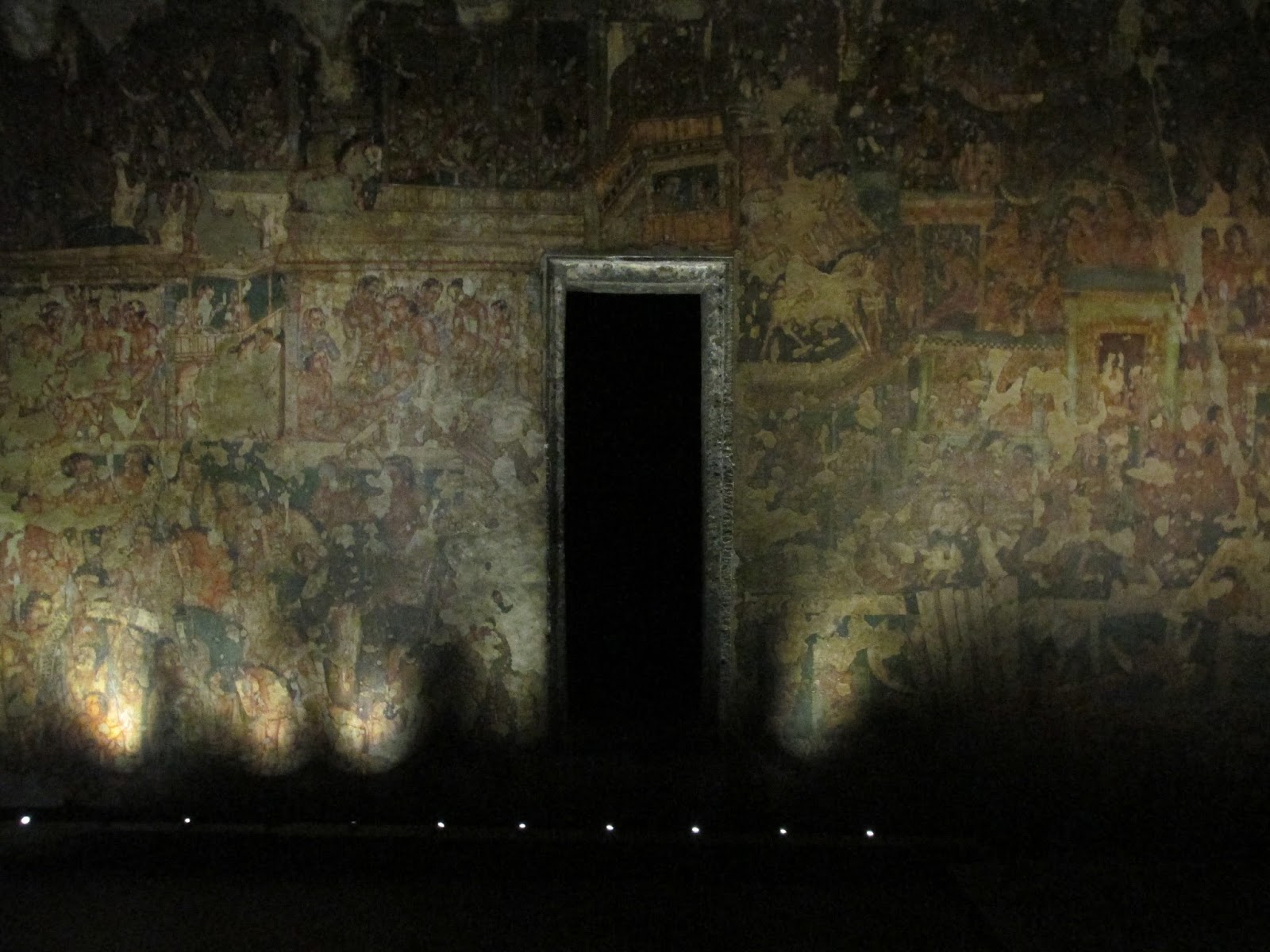
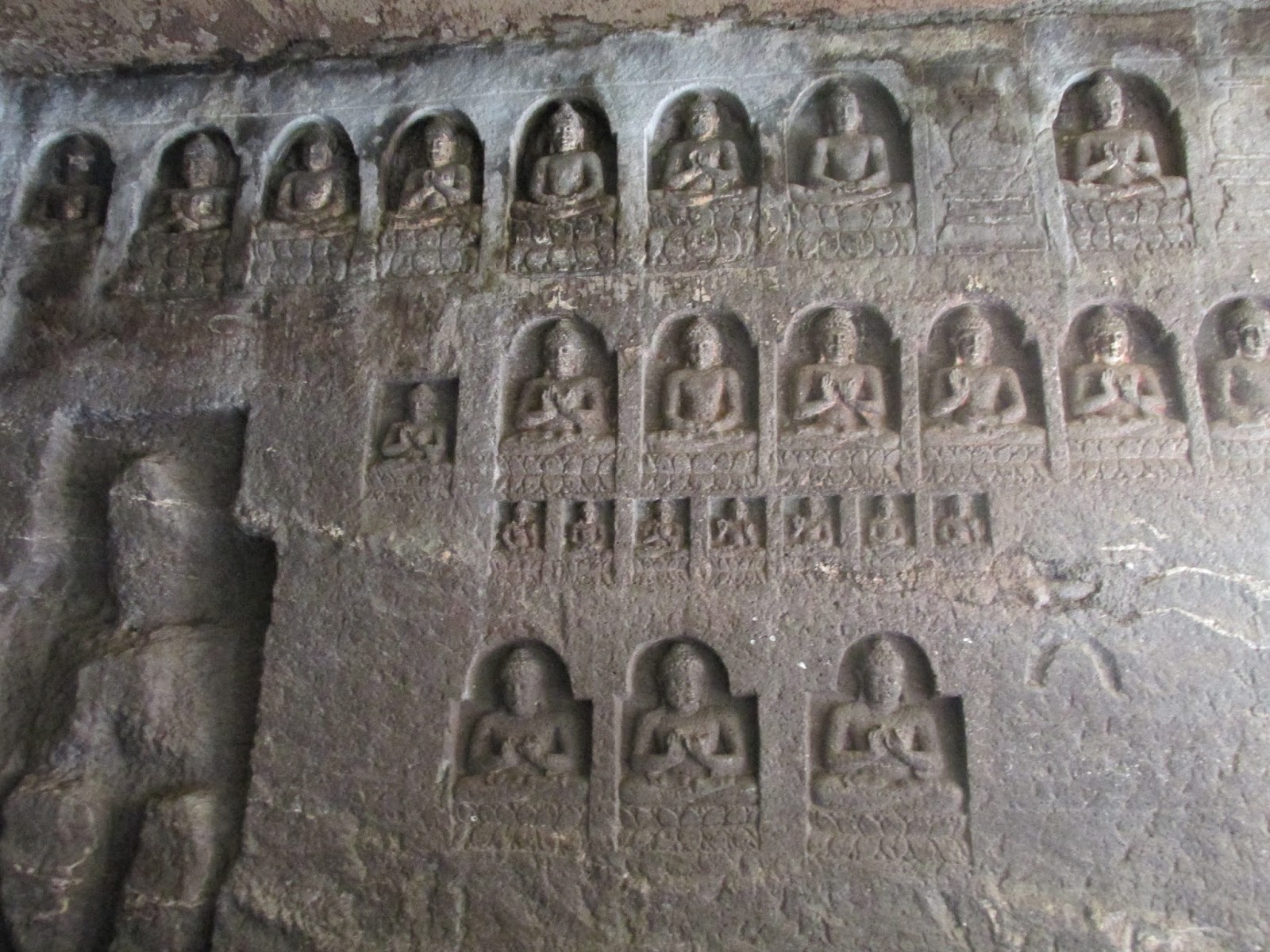
ancient Buddhist caves of Ajanta and Ellora.
These caves filled with sculptures and paintings dating back to 1 AD
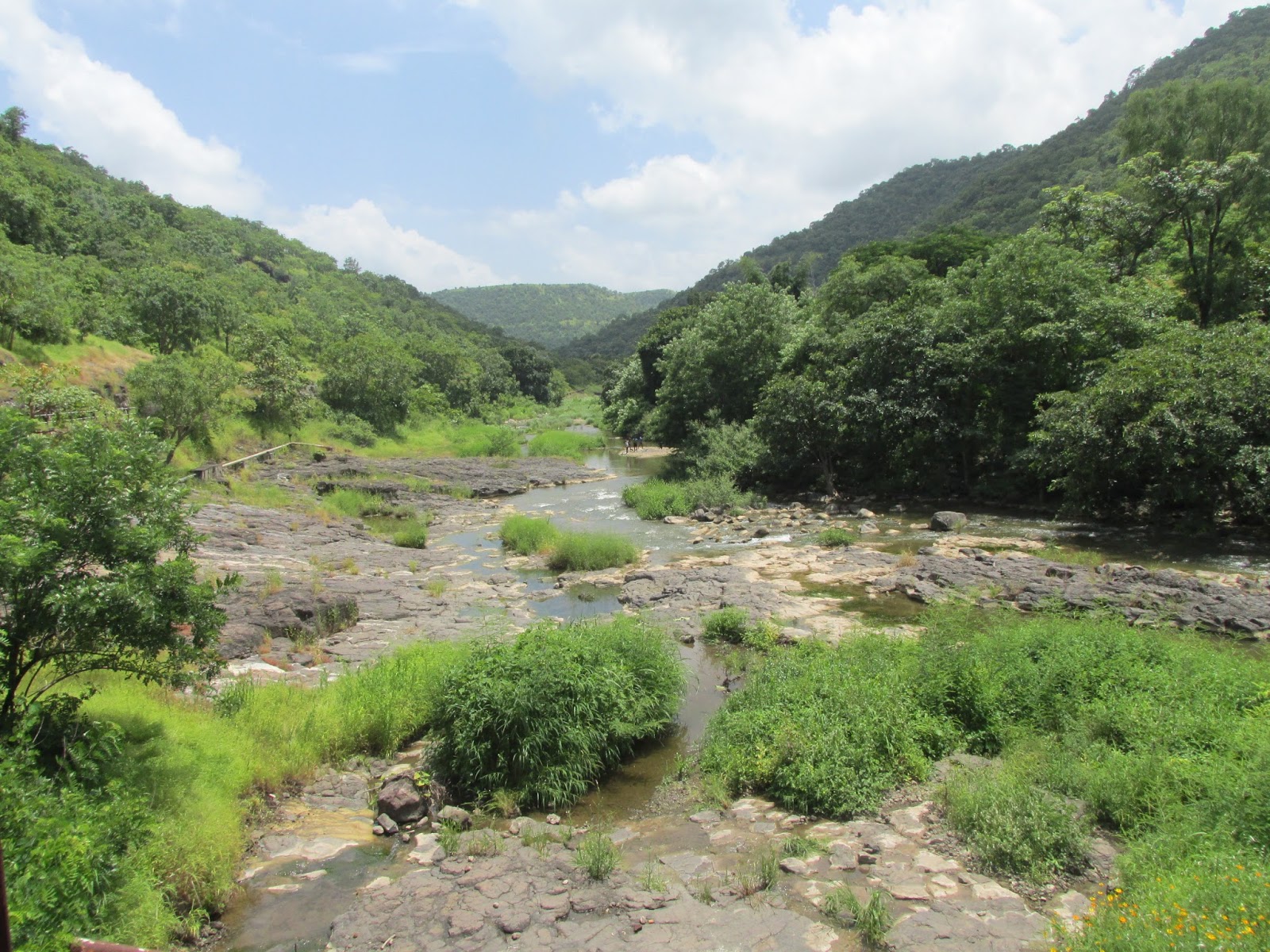
were absolutely breathtaking not to mention the tropical landscape and
waterfalls covering the land. So among
all this history and beauty you would find it hard to believe that us, 25
college kids from America, turned out to be the main attraction. It seemed almost every time we turned a
corner, a group of 50 Indian school kids would start screaming and chasing
after us to take a picture with us. I
made the mistake of agreeing to take a picture with one man and before I knew
it, I was swarmed by 20 other of his friends, everyone pushing and fighting to
get into the picture. Parents were
throwing their kids at us, people were fighting for chances to take pictures
with us- it was without a doubt one of the most bizarre situations of my
life. Talking with one of these men it
turns out a lot of them are farmers from remote villages who have never seen
foreigners before so it’s a big deal when they actually meet one.
Although humorous for the most
part, it brings to light another large difference between American and Indian
society- the acceptance of outsiders. A
foreigner in America would have little difficulty assimilating into American
culture and walking around relatively undetected as out of the ordinary. As a
white girl with red hair in India, no matter how well I can walk the walk and
talk the talk of Indians, my appearance screams ‘outsider, foreigner,
different.’ I can accept the stares and
curious looks while walking down the street- being mobbed by a group of 50
Indian school kids, however, will take some time getting used to.
Monday, September 2, 2013
Surprise! Internet does exist in India!
I’m kidding of course but it was a process which took a bit
more time and persuasion than I expected.
So here sums up my first week in India:
I passed airport security with a
bag full of 6-inch epi-pens and made it through a 15 hour flight where every
movie was in Japanese subtitles to finally land in Mumbai (or Bombay depending
on who you ask) last Monday evening. My
first 4 days in India were spent completing an orientation at a forest retreat
resort in Durshet. Most of the time was
spent covering cultural adjustment 101 with a trek to a local tribal village as
well as to a temple. By Friday we
reached Pune where we toured Furgesson College (where I’ll be enrolled) and met
our host families! The house I’m staying
at is only about a 10 minute walk from campus so Saturday was spent wondering
through the neighborhood with my roommate Annelise mainly on a search for Wi-Fi
which turned out to be an unbelievably difficult task. One thing quickly learned in India, however,
is to be extremely flexible and adaptable.
How to cross a three lane street that has somehow been converted into 12
lanes of speeding cars, mopeds, rickshaws and cows is another useful tool to
learn. Sunday we took our first day to relax, sleep in, and discover the disappointing 20% alcohol tax enforced in India . Monday we saw demonstrations of traditional Indian dance and music to help us decide which cultural immersion classes we want to take while in India and today I start my first day of school!
Considering my first days in India have
been primarily spent surrounded by 30 other Americans my first impressions of India
are watered down at most but the first and largest adjustment I’ve had to make
in India thus far is the food.
Remember that one time you bit into
a pepper that turned out to be 100x spicier than you imagined and it took you a
gallon of milk and a week rebuilding taste buds to recover? That basically sums up almost every Indian
meal I’ve had so far. Granted, I come
from a diet consisting of toast and vegetables seasoned with a dash of salt and
pepper when I’m looking for that extra ‘kick.’
Here though, breakfast, lunch, and dinner means all spice, all the
time. The spices they use here make
McCormick look like a joke. I really hope my body starts accepting this new
fare of food so I can eventually complete a meal without gulping a gallon of
water, crying, and/or ingesting India’s entire supply of Tums. I would consider eliminating any of these
reactions a success.
There’s really no differentiation
between the foods you eat at each meal- what’s eaten at breakfast is easily the
same kind of food that’s eaten for lunch and dinner. Most Indian food consists of rice with
variations of different kinds of vegetables and legumes mixed with a variety of
spices- sometimes chicken is used but very sparingly. I’ve quickly learned that utensils aren’t a
big component of eating a meal. Almost
every meal is eaten with chipati which is basically the Indian version of tortilla. The chipati is used as the main utensil to
pick up all other food with. So this
seems pretty unusual right? PLOT TWIST:
only the right hand can be used to pick up food and eat as the left hand is
deemed ‘unclean.’ It’s not necessarily a
hard way to eat but one that takes time to become accustomed to.
Eating
has proved to be a physical and mental struggle but one I’m sure I’ll get used
to in time. Besides that, India has
proved to be everything I imagined it- incredibly, ridiculously, unexplainably
beautiful. There is not a single sense
that India will leave untouched. The
land is covered in lush, misty tropics mingled with the aroma of incense and
spices constantly lingering in the air.
It’s a country where practicality outweighs comfort and where
self-governance outweighs political –governance. Although everything seems so exotic and new
to me now, I’m looking forward to continually accepting the normalcy of life
here.
Market in Durshet
Trek to a tribal village in Durshet
The local laundromat
Room where we spent about 80% of our time in while at orientation
Street Art
University of Pune
Rickshaws- main form of public trans around India
24 stories above Pune
Typical Indian fare
Building up spice tolerance is a daily commitment
Smoking out bugs during a game of cricket
Subscribe to:
Posts (Atom)